
Testors 1/48 Me163 Komet
By Brent Theobald
General History
(borrowed from the instructions)
The Messerschmitt Me-163 Komet was perhaps the most unusual and dangerous warplane to ever see series production. Designed by Alexander Lippisch, the Kometwas basically a high-speed glider fitted with a rocket motor. Prior to the war Lippisch was involved in designing tail-less and all-wing aircraft, most of them gliders. In 1937 the German Air Ministry’s research department asked Lippisch to design a plane to take a rocket motor being developed by Helmuth Walter.
The Me-163A was originally intended as a high speed research plane, but its spectacular performance coupled with the exigencies of war soon demanded that it be developed into a fighter plane. The Me-163B was designed from the outset as a fighter. Fitted with two cannon and armor protection for the pilot, it was supposed to break up the Allied bomber formations. The small size and incredible speed of theKomet caused much fear among bomber crews, as well as making it difficult target for their fighter escort. Fortunately, the Komet was only produced in small numbers. Its only weaknesses were its short endurance and the highly volatile fuels used to propel it, which sometime exploded upon landing.
The Komet was a true pioneering aircraft. The war forced its accelerated development despite its drawbacks. Its performance far exceeded anything of its time. The Komet was the first plane to scratch the sound barrier and its design parameters were soon to pave the way to the "jet age".
Specific History of the Komet Modeled
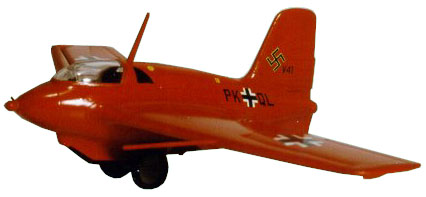
The Komet modeled is Me-163B-O V-41 Eprobungskommando 16, Bad Zwischenahn. Flown by Wolfgang Spate on the first operational mission of the 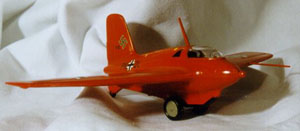 Me-163B. It is painted red in honor of Baron Von Richtofen, the ‘Red Baron’. Reportedly, Spate’s ground crew did not notify him of their intentions to paint the aircraft red. He was very displeased to fly the bright red Komet. This is understandable because the Komet had such a short powered flight. After the rocket fuel was gone the Komet was reduced to an armed glider. The pilot’s tactic was to attack then dive for cloud cover and run for home. After returning from the unsuccessful mission Spate had the Komet repainted in camouflage.
This plane and mission can be used to define the last days of the German war effort. A tremendous amount of effort, time, money and lives were spent in order to produce a miracle weapon to turn the war back in the favor of Germany. In spite of the great achievements and sacrifices of the Germans, the Komet could not begin to stem the tide of the war. One of many weapons which were simply too little too late.
Specifications
Wing Span 30’ 6"
Length 18’ 8"
Wing Area 210.97 square feet
Power Plant One Walter HWK 109-509A-2 bi-fuel liquid rocket motor
Maximum Thrust 3,750 pounds
Armament Two 30mm MK 108 cannon with 60 rounds per gun
Weight Empty: 4,200 pounds
Loaded: 9,500 pounds
Maximum Speed 596 miles per hour
Building the Me-163B Komet from Testors
I was a little apprehensive opening the box. This kit was originally designed and molded a long time ago by Hawk. I was worried I would find a piece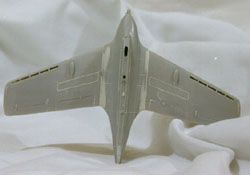 of junk inside the box. It was a pleasant surprised to find a mixture of recessed and raised panel lines along with some raised rivets where the wing fillet joins the fuselage. There was a small amount of flash. A few sink marks on the fuselage, but nothing I could not contend with. My first impression was the kit was definitely buildable.
The interior is the first step in the kit. This will not take too long because the interior detail is sparse. Merely a pilot, a seat and an instrument panel. The rear windows, spinner and landing skid are also shown to be installed at this time. The parts of the interior I felt would be visible were painted light gray (RLM 02). In retrospect a darker gray (RLM 66) would be more appropriate. The rest of the interior was painted black. The rear 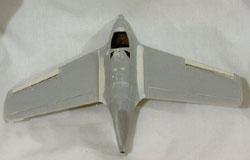 windows were left out until last because I dislike masking clear parts. The pilot was not used since he was a little lumpy. The fuselage halves joined without any problem.
Next are the wings. Two things to watch out for. First, do not cut off the trim tabs on the upper wing halves when removing flash. Look at the pictures. One modeler I know did this! Second, when gluing the wing halves together be aware the top halves have a notch cut out for the slats along the leading edge. The lower halves do not have this notch. Leave glue off these areas of the wings since they do not touch. The slats fit into the notches, leaving a small fillable gap.
Dry fit the wings to the fuselage. The wings had a bit of draft to them where they would join to the fuselage. A small bit of filing flattened this area out. The holes in the fuselage needed to be enlarged so the tabs in the wings would fit properly. These small steps were required to reduce the gap between the wings and fuselage.
The flaps did not fit very well into the bottoms of the wings. They were too small in shape and too tall. I filed them down before gluing them in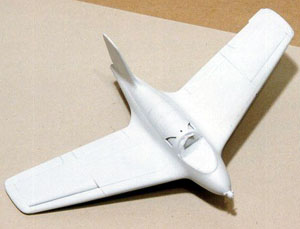 the closed position. I used putty to fill the gap around the flaps. The easiest way to fix this would be to build the kit with the flaps down.
Sink holes and wing root gaps were filled with putty at this point. After getting the holes and gaps filled to my satisfaction I re-scribed panel lines I had sanded off. I use a cut off needle clamped in a pin vise for this. The model is now ready for priming.
I decided to paint the Komet red instead of the usual camouflage scheme I am used to seeing it in. The bright red aircraft with black markings will be striking. The symbolic link with The Red Baron is interesting too. I am of the opinion the red paint job will be much easier than the fancy camouflage the Germans seemed to love. I was wrong.
A coat of Krylon sandable primer is first. This serves two purposes. One to fill any minor scratches I may have missed during final sanding. The second is to give the plane a uniform color. A uniform color is desirable because red paint is notorious for not covering well. I did not want the white putty showing up lighter then the surrounding gray plastic. After testing on a scrap model it was decided the red paint over the gray primer would be too dark, so I gave the plane two coats of white paint. Remember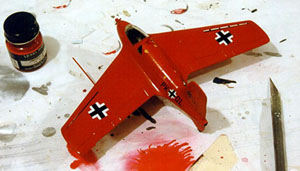 to sand with 0000 grade steel wool between each coat. This will help the next coat be nice and smooth. Be sure to use a tack cloth too. This will pick up dust particles and pieces of steel wool. I painted the plane with Testors Insignia Red. I tried my best to cover the plane evenly. Unfortunately the model still had light and dark stripes. After letting the paint dry over night I sanded it lightly and cleaned the model with the tack cloth. The second coat of red paint made the model a uniform color of red. After letting the paint dry again over night I did the sanding and tack cloth trick again. Now I added a coat of Future floor wax. This gave the model a uniform finish as well as a uniform color. It was certainly a lot more work than the one shot of red paint I had envisioned. A splinter scheme could have been done as fast, but I am happy with the results. It is a very striking aircraft.
Now I added the wheels. No sense letting the workbench tear up a nice glossy paint job!
Next was the application of decals. These covered the red paint 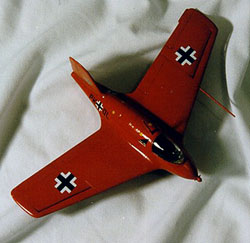 well, although I was concerned they would not. At this point I added the pitot tube, canopy, rear glass, and aerial which I had painted earlier. Another coat of Future and I called the Komet complete. I decided against weathering because this Kometwas only painted this way for a matter of days. I wanted the Komet to appear as it did when Wolfgang Spate first laid eyes on it.
This kit was a very quick build for me. Anytime I felt there was a problem with the kit I reminded myself I could try to find the Trimaster/DML kit of the same plane. This kit cost a little over five bucks and it is hard to complain when that is kept in mind. This is a kit with a large amount of potential that an experienced modeler can turn it into a really great model of the Me-163. The kit is also simple enough that a beginner modeler can also build a really great model straight out of the box. It is a good modeling value, no matter what your modeling skill may be. I would recommend the Testors Me-163B to any modeler.
Reference Sources Aircraft in Profile Volume 11 (No. 225) Wolfgang Spate and Richard P. Bates (Doubleday) Rocket Fighter (The Story of the Messerschmitt Me-163), Mano Ziegler (Squadron/Signal Publications)
Messerschmitt Me-163 Komet, Aero Series Volume 17, Edward T. Maloney (Aero Publishers Inc.)