Gavia 1/72 LET L 410UVP
By Chris Banyai-Riepl
 |

|
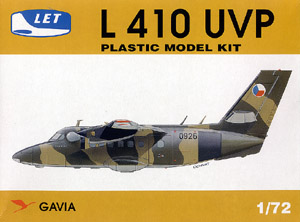
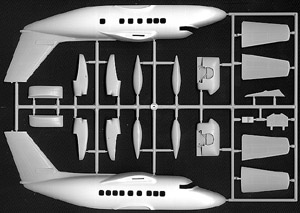 The L.E.T. company has a long history of building aircraft in Czechoslovakia (now the Czech Republic), and some of its vast product line include Blanik gliders, the L 29 jet trainer, and the L 410 and L 610 commuter turboprop airliners. The L 410 is the subject of this 1/72 Gavia kit, and it is a very well done kit indeed.
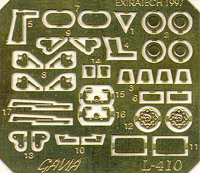 bulkhead and a rear bulkhead. The pilot and co-pilot seats are made up from four pieces, and the control yokes are etched brass.
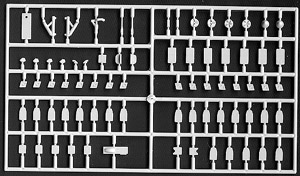 the inflight magazines. While giving us this interior adds quite a few fiddly bits to work with, it is a pleasure to see a company going this extra step and providing the parts for something that would be tedious to scratchbuild.
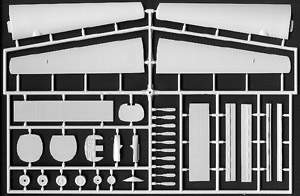 The rest of the kit is just as nice as the interior. A choice is given for either a three-bladed or five-bladed prop, and optional wingtip tanks are provided as well. The landing gear sponsons are well thought out and look to be very well fitting. Even if they aren't, they are designed so that it will be easy to fill and sand the joint to the fuselage, with a minimum of damage to the surrounding surface detail, which is very finely recessed. In fact, the surface detail rivals that of the Hasegawa Spitfire VIII and Academy Hurricane IIc currently on my desk.
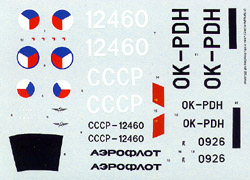 Once all of those plastic and metal parts are thrown together, it's time to paint it up and slap the decals on it, and here comes some more tough decisions, as the kit comes with three choices of markings. Even though this is a commuter airliner, several L 410s have found their way into military service. One of the decal choices reflects this, providing markings for a Czech Air Force L 410 T. This one is camouflaged and carries the standard Czech markings in all six places. It is also depicted on the boxtop. Somehow, though, it just seems wrong to build a kit with such a great airliner interior and paint it up in military markings. It seems that Gavia thought similarly, as in addition to the one military version they provide two civilian options.
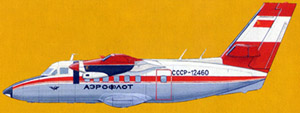 The first one is for an L 410 UVP from Aeroflot, decked out in red, white and gray. I don't know where this one was flying, but it is finished up like it might get lost in the arctic or something. The wings are red from the wingtips to the engine nacelles, fuselage top is white, and the bottom is gray. Coupled with the red USSR flag (this is a pre-breakup L 410) and the red cheatline, this one will really stand out.
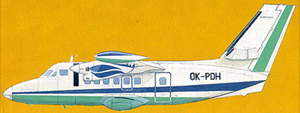 blue green accents. Just think of this one as a big turboprop learjet, and you're probably pretty close to the mark.