The Curtiss Model 75 was the beginning to a long fighter lineage. This
diminutive radial-engined fighter marked the beginnings of the classic
P-40 design which went on to fight on just about every front of the Second
World War. The Hawk 75 received mediocre attention at home under the designation
of P-36 but abroad is where it really shone. British examples saw combat
in South East Asia while those flown by Finnish pilots achieved great
success against Russian planes.
The Kit
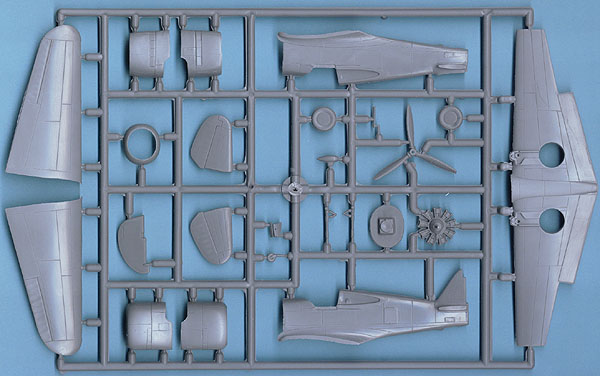
AML's kit of the Hawk 75 is a great addition, as earlier kits of the
Hawk 75 suffered in different areas. This kit looks to be quite accurate
and includes two different cowls, although only one is outlined for use
in the kit (and it looks like the cowling for a P-36, so keep an eye open
for that one in the near future). The parts are all crisply molded in
gray plastic that has a soft look to it. But the panel lines are sharp
and nicely recessed.
The interior is made up of resin and brass, with sidewall detailing
molded into the plastic fuselage halves. The detailing compared between
the resin and plastic parts is quite good in both areas, and once painted
it will be hard to tell what was resin and what wasn't. The instrument
panel is the usual etched brass affair, with clear film instruments.
The
engine is injection-molded and while it could stand some cleanup it should
really look sharp, especially if you go the extra mile and add wiring
to it. The cowling is in two pieces (with the alternate one being made
up of three) and while there will likely be some clean up required, the
fit to the forward fuselage looks to be pretty good in a dry run.
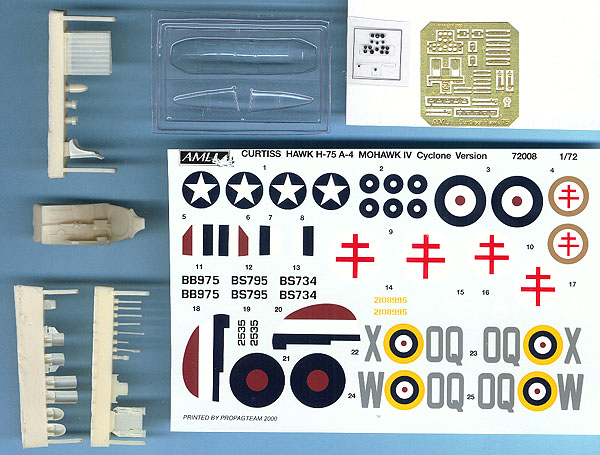
The wings are nicely done, with full wheel well detailing provided.
The wheel holes have sides and the floor of the well is provided in resin
as a thin insert of ribbing. The one-piece lower wing ensures that the
dihedral will be just right, and the ailerons molded into the top half
of the wing have thin trailing edges. I just wish they had done something
similar with the flap section. Some thinning will be needed there to get
the same look as the ailerons.
The rest of the assembly is straightforward, leaving you with little
else other than to choose which marking option. AML sure didn't make this
one easy, either, as they include decals for no less than four Hawk 75
A-4s. The first one is actually a P-36G of the USAAC, diverted from a
shipment to Norway. Standard OD and gray scheme with yellow serials make
this a somewhat bland looking plane, but sitting next to one of the fancy
P-36s from before the war will leave people noticing the subtle differences
between the two.
There
are two choices from Southeast Asia, one of No 155 Squadron and the other
as seen on the box top artwork. The one from No 155 Squadron is in dark
earth and dark green, with the name "Joe Soap II" under the
canopy. The box top one, oddly enough, is listed as being in dark green
and ocean gray, contrary to the illustration on the box. Which one is
correct, I don't know, but I would lean towards the box top illustration.
The final choice is a French example, flown by Commandant Tuslane. This
one is finished in dark green and dark earth over medium sea gray and
carries the cross of Lorraine in six positions. Tuslane borrowed this
plane from the Kasfareet Air Depot on the Suez Canal and flew it in combat
in Syria, before returning it to the SAAF..
Conclusion
This is a nicely done model of a little-known subject and AML should
be commended for the excellent job they did on this one. While it won't
exactly fall together, it will build up into a nice replica and with the
large number of interesting schemes you could easily build half a dozen
of these and not have any two in the same country's markings.