The Sd.Kfz. 250 was developed following a mid-1930's requirement for
a one ton (0.95 tons) half track, to provide mobility for infantry and
other units operating with panzer divisions. The first example appeared
in 1939 and saw action for the first time in May 1940 during the invasion
of France.
Production continued until 1944, with later models having redesigned
hulls to make manufacturing easier and cut down on the amount of raw materials
required, as the basic design was rather expensive as it was.
Variants included a communications vehicle (subject of this new kit),
a mobile observation post, as well as a number of specialized weapons
carriers. These last mentioned vehicles mounted everything from anti-aircraft
guns to anti-tank cannons. The vehicle remained in service until the end
of WWII, proving to be a reliable and popular half track.
Four OFFICIAL versions of the Sd.Kfz. 250/3 'Leichter Funkpanzer' (Light
radio panzer) were in existance. Each of these was a radio vehicle with
equipment to suit the particular formation which it was to accompany and
the command to which it was to report. Thus, the model attached to motorized
forces was equipped with the Fu 12 radio set, which was the normal ground
forces link with such formations. The Fu 12 was a medium wave receiver
operating on the 835-3000 Kc/s. band and an 80 watt transmitter which
used the 1120-3000 Kc/s. band. A 2 metre rod with star antenna at the
top was the aerial for these Fu 2's. This aerial was carried at the rear
left of the fighting compartment while the usual 2 metre rod aerial for
the inter-vehicle Funksprechgeraet f was on the front right. The radio
set itself was carried on top of the petrol tank which was reduced in
height. The main armament was one MG 34. Again, both pre- and post-1943
bodies were to be seen.
The second type of radio had an Fu 7 radio set, which consisted of an
ultra-short wave receiver d1 and a 20 watt transmitter which operated
on the 42100-47800 Kc/s. band. The Fu 7 was used to contact Luftwaffe
support groups inside the range of 50 Kms. The aerial was again a 2 metre
rod aerial.
The third model was another ground-to-air coordination vehicle and
as such was usually operated by Luftwaffe personnel and therefore had
the WL license number of the Luftwaffe. Not only did these vehicles carry
the Fu 7, the aerial for which was mounted on top of a armored container
at the rear, but also an Fu 8 which was characterized by a massive frame
antenna. These Fu 8 sets were for contact with the main divisional command
at ranges up to 40 Kms. On later models the frame antenna was replaced
by a 8 metre winched mast aerial with a star antenna on top, which could
be raised and lowered as required. The 8 metre mast increased the range
to 50 Kms. The Fu 8 was a medium wave receiver c for the 835-3000 Kc/s.
band, while the earlier model b was for the 580-3000 Kc/s. band. The transmitter
was a 30 watt unit operating between 1130 and 3000 Kc/s.
The final model of the radio vehicles seems to have been a general
type, with no specific radio sets mentioned in official documents. However,
reports indicate that they were fitted with Fu 15 or Fu 16 for contact
with assualt gun formations, and with the Fu 10 when attached , for example,
to armored car groups. The ordinance numbers for these vehicles were:
Sd.Kfz. 250/3.I, Sd.Kfz. 250/3.II, Sd.Kfz.250/3.III, and Sd.Kfz. 250/3.IV.
I would say that this kit would most likely be the third type mentioned
above.
TECH DATA:
CREW: 6 WEIGHT: 11,835 LBS DIMENSIONS: length 14ft. 11.5in., width 6ft. 4.6in., height 6ft.
6in. RANGE: 186 miles. ARMOR: 0.23 TO 0.6 inches. POWERPLANT: One 6-cylinder, petrol engine developing 100hp. PERFORMANCE: Max road speed 37mph. Fording capacity: 29.5 inches
of water. Vertical obstacle climbing capability: 6ft. 6.7in.
WHAT'S IN THE BOX?
This is the sixth kit in DML's septet of basic Sd.Kfz. 250 kits that
they have released. It is also the last one they have announced.
Most armor modelers will instantly recognize this vehicle as the type
favored and used by Rommel in North Afrika, with the nick-name 'Greif'
(GRIFFIN) painted down its sides. As a little aside, Rommel also had a
second Sd.Kfz. 250/3, that he used, that had the nick-name 'Adler' (EAGLE)
painted down the sides. However, 'Greif' seems to have had more pictures
taken of it during the war.
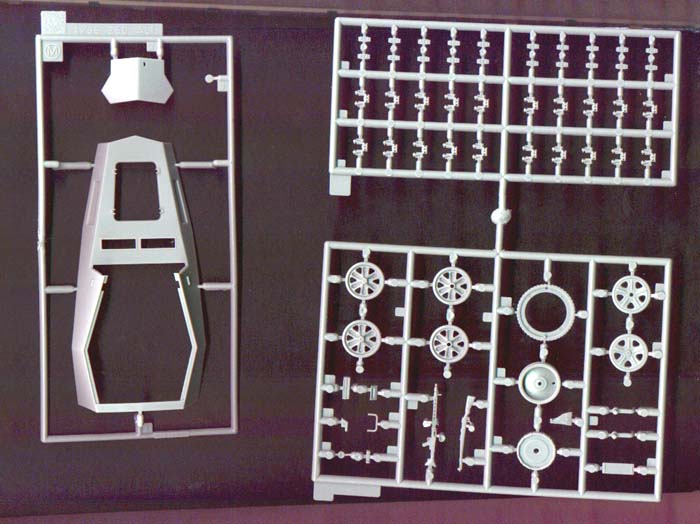
The kit contains 19 light plastic trees of parts and two pieces of nylon
mesh screen (for engine intake vents), decals, and the instruction sheet.
Like its five predecessors, this kit shares some common parts trees with
the other DML 250 kits. I will mention the new trees first.
There are two letter 'A' trees in the kit. The smaller of the two holds
the radios and their tubular frames, the vehicle's rear compartment floor,
etc. 16 parts on this new tree. Part no.16 is blued out on the instructions
and is not used.
There is a fifth letter 'F' tree in the kit. The other four letter
'F' trees are for the individual track links and are common to all the
250 kits. This new, smaller, tree holds parts for a 'DONKEY EARS' binocular
on a tripod (10 parts).
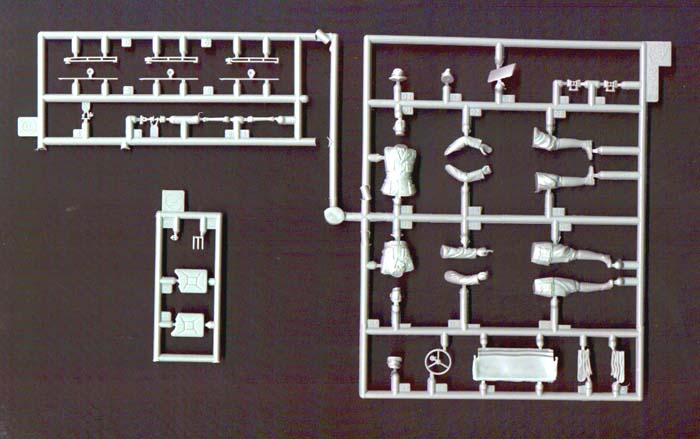
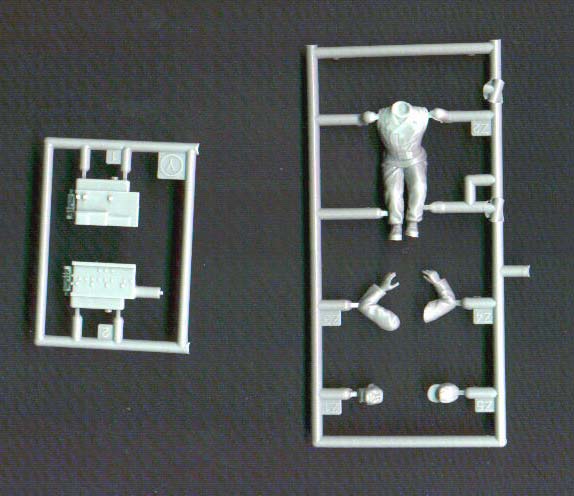
A tree, bearing no alphabet letter, but having the numerals 9042 on
it, holds parts for a figure of Rommel and another standing officer, two
pairs of binoculars, a soft peaked cap, a three-spoked steering wheel,
and some folded tarps. The steering wheel and the tarps are blued out,
as not to be used on the instructions. There is a four-spoked steering
wheel on another tree that is used - so don't despair. (22 parts).
There are three small trees, holding four parts each, that make up into
jerry cans.
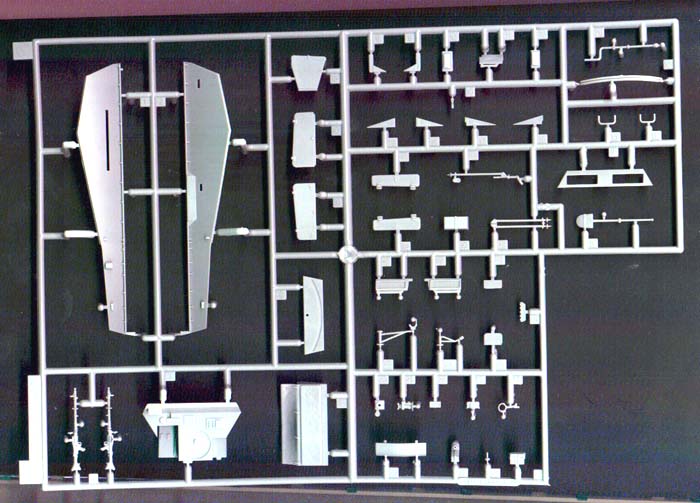
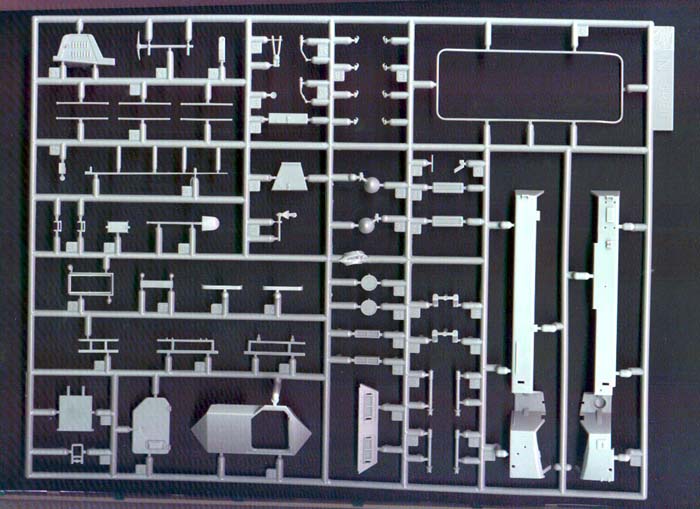
Finally, a new letter 'N' tree holds the main banister type aerial,
its supports, fenders, vision ports, tools, jerry can rack, rear vehicle
wall and door, etc. (65 parts - six of which are blued out on the instructions
as excess)
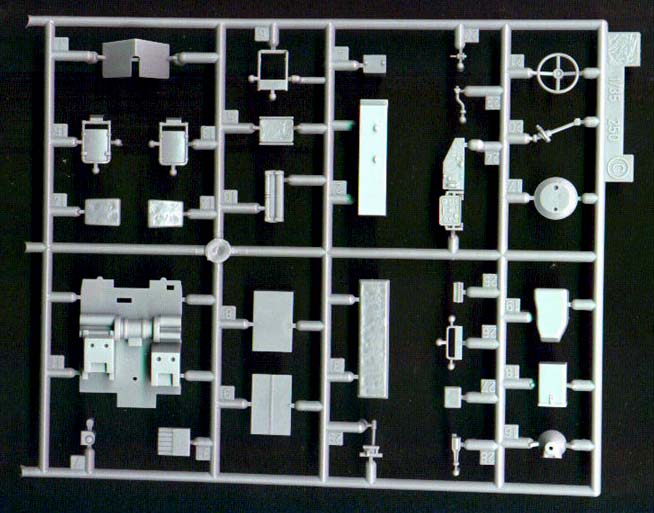
The rest of the parts trees are common to the earlier released 250
kits. First amongst these is the large letter 'A' tree. It holds the vehicle's
sides, suspension parts, notek lamp, tow hooks, drive sprockets, steering
gear, vehicle frame, and other small fittings. (40 parts here - with nine
blued out on the instructions as excess).
Tree letter 'B' is the road wheels, some rifles, and small fittings.
There are a total of four of this tree, with 21 parts per tree. Seven
of the parts on these trees are blued out.
Tree 'C' holds the vehicle's driver's compartment floor, steering wheel
(the 4 spoked one), seats, and other fittings. (30 parts - with 8 blued
out).
Four larger letter 'F' trees hold the individual track links with their
separate rubber pads. (40 parts per tree).
Letter 'M' holds the vehicleís top, nose plate, and a small round plate
(just three parts here)
Letter 'K' is the vehicle's sides, dash board, machine guns, various
panels and fittings (46 parts here---with nine blued out).
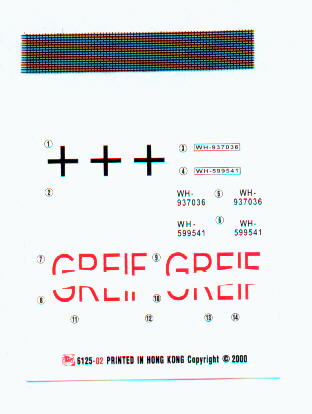
Decals are included for two vehicles: Rommel's 'Greif' (Tobruk 1942),
and a vehicle of the Grossdeutschland Division, Eastern Front 1942.
The instruction sheet is a 10 page, gatefold sheet. There is NO HISTORY
of the vehicle on this sheet. Readers of my past reviews of DML kits will
know that this is my pet peeve with them. 30 assembly steps walk you through
the building of the kit, followed by a page of painting and marking guides.
As popular as Rommel was - his favored vehicle should sell well to
armor buffs. This looks like a great kit - as were the earlier five versions
of the 250.
In the past, Airfix released the 250/3 in 1/32nd scale years ago. Tamiya
has done the vehicle also in 1/35th. Which one is the best? I just don't
know! But, DML's looks darn good.
I bought this kit at the local hobby shop. It should be readily available
at any well stocked shop.