
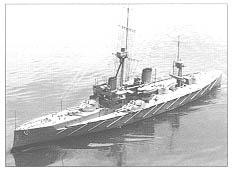
 The first chapter walks us through this period, and looks at the various types that came and went, as well as those that have stayed the course - battleships and battlecruisers, the inter-war peace and rearmament, the Second World War and aircraft carriers - there is a lot of history packed in a small chapter. All this takes us neatly into what the Royal Navy is today – a small, but capable, fighting force, as proved in the Falklands War (with no help from other Navies), as well as the Gulf War, and beyond with other UN actions, where the RN fills a role no other Navy could do as well, not even the USN (who entrust the protection of several of their mighty vessels to the care of the RN).
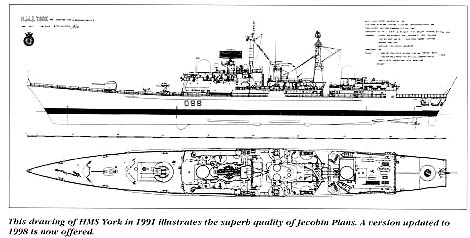 Chapter Six looks at Plans and Information - here you are taken through what to expect from the available plans, and what NOT to expect. Guidance is given on what you should look for in plans - some are just that, a set of drawings of the relevant vessel. Others have some information for model builders while others still are aimed exclusively at the builder, and have almost everything you need - 'almost' being the word, as what is portrayed in the plan is not necessarily the ship when you want to build her, or may even be a generic plan of the class. Research is the word here, and cannot be over-emphasised. So once you have a set of plans you are happy with, the chapter finishes on how to read them, and has plenty of useful hints.
 decks.
 Chapter Fifteen looks at the Type 22 frigate - more specifically, HMS Campbeltown, a Batch III vessel. Her history is examined, as is her appearance (did you know her badge is a lemon tree?). Available plans are looked at, as are available hulls, before various building notes are covered.