• Menu
  • Home
  • Columns
    • Industry News
    • Editorials
    • Now and Then
  • Features
    • Armor
    • Automotive
    • Aviation
    • Figures
    • Ships
    • Space/Sci Fi
    • Special Reports
  • How To
    • Construction
    • Detailing
    • Painting
    • Finishing
  • First Looks
    • Armor
    • Automotive
    • Aviation
    • Figures
    • Ships
    • Space/Sci Fi
  • New Releases
    • Armor
    • Automotive
    • Aviation
    • Figures
    • Ships
    • Space/Sci Fi
    • Book Reviews
    • Tools
  • Gallery
    • Armor
    • Automotive
    • Aviation
    • Figures
    • Ships
    • Space & Sci Fi
    • Drawings
    • References
Internet Modeler : First Looks: Aviation RSS News Feed

Luedemann Modellbau 1/72 Resin Lloyd 40.05 "Flugzeugjaeger"

By Volker Haeusler
History

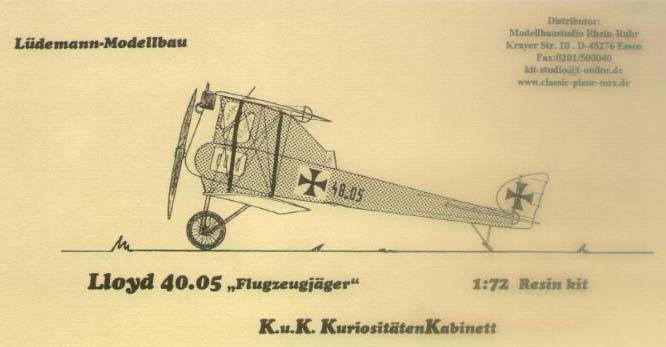
Already before WW I, a number of developments took place to transform the aircraft into a weapon. Most of these were centered on the pusher typer aircraft, which could easily mount a gun pointing and firing the direction of flight. However, when it came to mounting such a gun in the aerodynamically and strengthwise more sensible tractor aircraft, the problem of avoiding the propeller existed. This was a problem that was not solved until the advent of machine gun synchronisation. Before that moment, some strange and bizarre aircraft were created to create an aircraft to chase other aircraft - a "Flugzeugjaeger" in German. The Lloyd 40.05 is a prime example of such a creature.

The Ungarische Lloyd Fklugzeug- und Motorenfabrik in Aszod, Hungary, a Austro-Hungarian subsidary of the Deutsche Flugzeugwerke (DFW) of Germany, build this strange aircraft. Like most of the Lloyd aircraft, it used veneer covered wings instead of fabric covered ones. This obviously helped to reduce drag, but resulted in numerous problems in the field, ranging from problematic repair to rapid deterioration due to the build up of moisture.

The 40.05 "Flugzeugjaeger" was built in early 1916 and flew for the first time in late spring 1916. At that time, the Fokker (and Pfalz) monoplanes with synchronized machine guns were already in widespread use on the western front, and had also arrived in Austria-Hungary. Therefore the strange Lloyd design was already obsolete before it ever flew, a fact contributing to its rapid disappearance.

Designwise, the Lloyd was a comparatively conventional biplane, with the exception of the veneer covered wings already mentioned. Its main design feature was the position of the gunner, who was positioned above and behind the engine in the upper wing centre section. While this gave him a all round view and potentially field of fire, the pilot, hidden behind the small "tower" holding the gunner, had no forward view at all. Besides the practical problems of communication between the occupants, take off and landing would have been extremely hazardous, to say the very least.

It seems the gunner was given some auxiliary means of steering control, which he could have used in combat. However, there could be no doubt about the fact that the aircraft was a dangerous misconception, which also possessed an uninspiring performance. Lloyd tried to change the design to a single seat configuration, but to no avail.

Alltogether, the Lloyd 40.05, with its unfortunate veneer wings, dangerous pilot position and low performance must be rated as one of the true failures of WWI. However, the design definitely looks bizarre enough to appeal modellers.

The Kit

One of the newest Luedemann Modellbau resin kits, the Lloyd 40.05 belongs to that manufacturers "k.u.k. Kuriositaeten Kabinett" series - I don't think I have to translate that.


Compared to most of the other Luedemann kits, the 40.05 is rather simple and contains fewer parts.

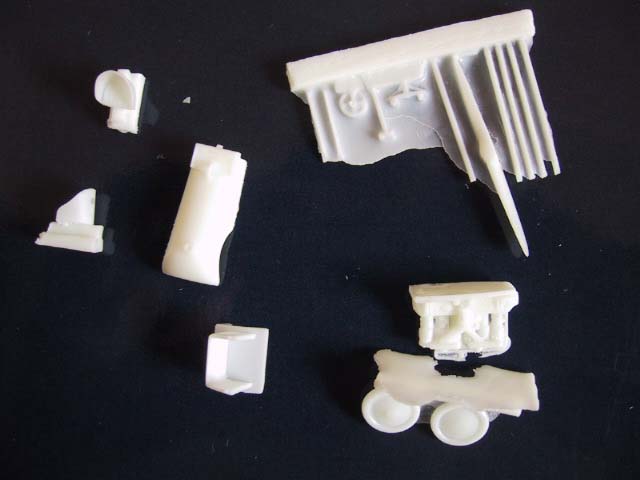
The fuselage is molded in one piece with cutouts for the pilot and engine/gunner. The cockpit area therefore lacks some depth, and is not very detailed. However, there is a (very fine) seat, a superb rudder bar and a two part control column/wheel to fit into the area. Superdetailers will maybe want to cut away the cockpit area for additional detailing of the sidewalls. There is an adequate Daimler engine, a nicely detailed "tower" for the gunner and a well fitting nose section with integrally molded car type radiator to complete the fuselage. As with the pilots cockpit, the gunner's cockpit also lacks some detail and also looks slightly to small when compared to one of the rare photos of this aircraft.

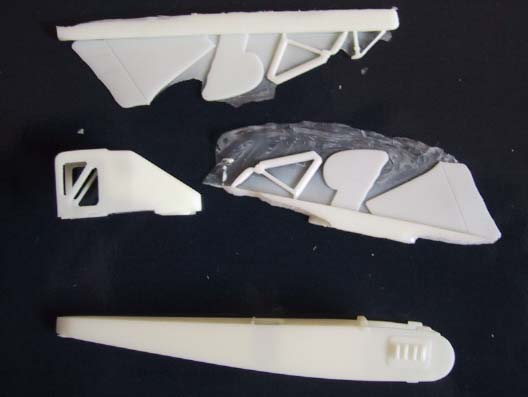
The wings come in four parts, two upper wing parts with ailerons and two lower wings. As the original was veneer covered, the wings correctly lack any rib detail, but feature some very fine recessed panel lines. The fabric covered ailerons feature some very neat rib detail. Altogether, the wings look extremely convincing. Like the wings, the fin and rudder carry superb detail and are very thin in section, an area where the Luedemann kits really set new standards.

The kit also provides very thin interplane struts and undercarriage legs. While the wheels look very good, they are fitted with solid wheel disks. However, all 40.05 photos I know show spoked wheels, so super detailers should replace these wheels with aftermarket photo etched ones.

The kit comes with a single page instruction sheet, containing a 3 view drawing, two photos and a brief description of the history and color scheme of this obscure aircraft.

Conclusion

The Lloyd 40.05 is definitely an aircraft that few of us would ever have expected in kit form. Like all Luedemann resins, this kit is very well done, with superb surface detail and extremely thin flying surfaces. Compared to the other Luedemann kits I have seen, the cockpit detail is a little basic, but this is easily corrected. Luedemann and the distributor, Modellbaustudio Rhein-Ruhr, have provided us with another little gem that will attract a lot of attention where ever you show it. I hope the "k.u.k. Kuriositaeten Kabinett" will provide us with many more of these oddities.