• Menu
  • Home
  • Columns
    • Industry News
    • Editorials
    • Now and Then
  • Features
    • Armor
    • Automotive
    • Aviation
    • Figures
    • Ships
    • Space/Sci Fi
    • Special Reports
  • How To
    • Construction
    • Detailing
    • Painting
    • Finishing
  • First Looks
    • Armor
    • Automotive
    • Aviation
    • Figures
    • Ships
    • Space/Sci Fi
  • New Releases
    • Armor
    • Automotive
    • Aviation
    • Figures
    • Ships
    • Space/Sci Fi
    • Book Reviews
    • Tools
  • Gallery
    • Armor
    • Automotive
    • Aviation
    • Figures
    • Ships
    • Space & Sci Fi
    • Drawings
    • References
Internet Modeler : First Looks: Aviation RSS News Feed

RPM 1/35 Sd.Kfz. 135 UNIVERSAL TRANSPORTER (EX-FRENCH L37L INFANTRY CARRIER) KIT NO. 35021 & BEOBACHRUNGSWAGEN COMMAND VEHICLE (EX-FRENCH L37L INFANTRY CARRIER) KIT NO. 35013

By Ray Mehlberger

MSRP: $29.98 
Greatmodels price: $24.75


HISTORY

The Lorraine was a French infantry carrier. In the early 1930s the French army required a replacement for their existing Renault light tracked infantry carriers, and the Societe Lorraine, builders of railway rolling stock, developed a vehicle known as the Chenillette Lorraine Type 37L. This was a simple tracked carrier for infantry or cargo, with a two-man crew protected by small cupolas. It carried no armament. Suspension was by three twin bogies on each side, with leaf springs.

A second version, the Chenillete Legere, had two twin bogies, was shorter, and was used solely for infantry work. Production began in 1937, but in 1939 was moved to another factory. This interrupted the flow, and in consequence not many were built.

In 1940 an armoured personnel-carrying version was built, with the hull sides built up with armour at the rear to form a protected passenger compartment. After the fall of France, almost all of these vehicles were taken over by the German army and most were then used as a basis for a variety of self-propelled guns, mounting calibres between 75 and 150 mm. Some, like the subject of this kit were used for artillery towing and command vehicles. In German service they were known as the Sd. Kfz. 135.

At the end of the war the French army modified one or two by fitting the British 17 pdr. anti-tank gun in the rear compartment, facing forward between the crew cupolas. The gun could not be fired while on the move and these modified vehicles were more in the nature of mobile anti-tank guns than a self-propelled artillery.

Tech Data:

Weight: 5650 kg. (5.56 tons) 
Length: 4.21 m (13 ft. 10 in.)
Width: 1.58 m (6 ft. 2 in.)
Height: 1.22 m (4 ft.)
Armour thickness: 8 mm (0.238 in.)
Powerplant: One Delahaye 135, 8-cylinder gasoline engine of 70 bhp. at 2800 rpm.
Speed: 30 km/h (22 mph.)
Range: 135 km (84 miles)
Crew: 2

WHAT'S IN THE BOX ?:

The kits come in a tray and lid type box. It is rather BLOUSY, as...when you open it there is a letter 'L' void of some size around the contents.

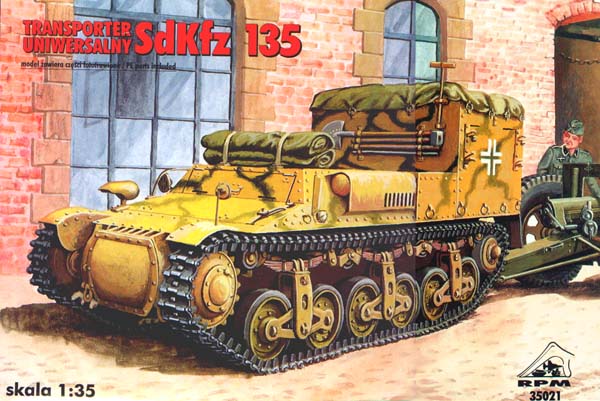
The box art painting of the universal transporter shows the vehicle parked next to a building with an unidentifiable field piece in tow. Behind the field piece is a German soldier taking a smoke break. There are no figures included in the kit and the canvas covers shown mounted on the vehicle are not in the kit either. The side of the box shows two color profiles of a couple of paint schemes for the vehicle. One is overall panzer gray and the second one is earth yellow with red brown wavy lines.

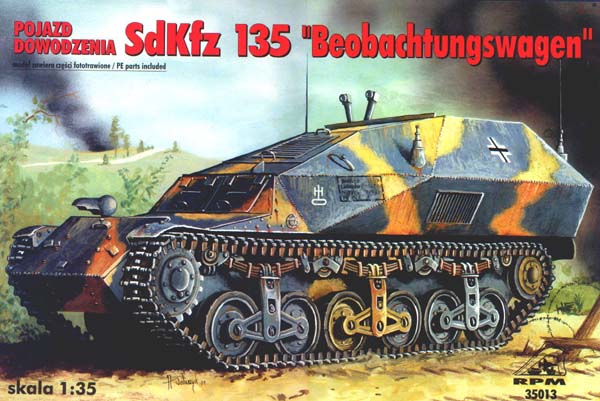
The command vehicle shows the vehicle in the field, just crossing a barbed wire obstacle. There is smoke on the horizon. Many weld seams are shown on the edges of the upper armor plating of this vehicle. The kit parts of this armor structure do not have the weld seams. If this painting is correct the weld seams will have to be duplicated by the modeler. One side of the box shows two color schemes for this vehicle. One is a wave pattern (identical to the box art) the other is more of a spotted pattern.


UNIVERSAL TRANSPORTER


COMMAND VEHICLE

All the plastic parts trees are in one cello bag. A second cello bag holds the decals, instructions, and a fret of brass PE parts.

None of the parts trees in each kit are either letter coded or numbered on the sprues. You have to use the parts tree drawings on the instructions, and go back and forth between them and the particular parts tree shown to identify each part. This will make for extra time required for building.

Parts also do not display any location pins and associated holes they go in for positioning parts. Most parts are butt joined. So careful dry fitting, before glueing, is definitely in order here.

The colors of the plastic used to mold both kits is almost technicolor in variety.

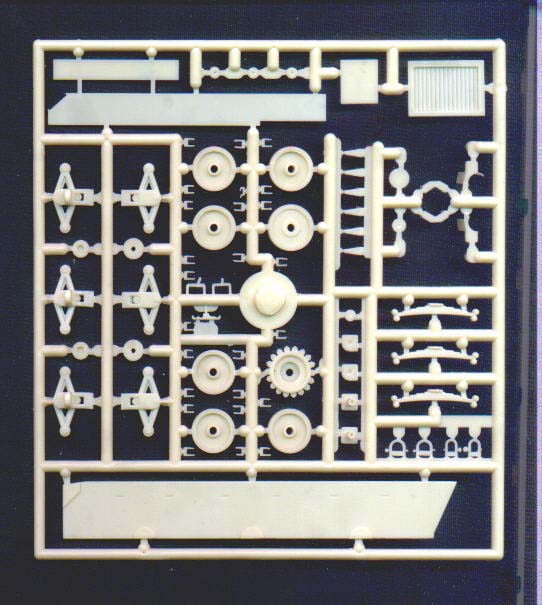
The largest tree is molded in a light gray-green. It holds the upper superstructure, the nose piece, transmission cover, tools, vehicle floor, bulkheads, vented muffler shield, horn etc. (35 parts here)

Next down in size are two identical light tan colored trees, which hold bogies, leaf springs, road wheels, drive sprockets, air intake panel, side panels etc. (156 parts on these two trees)

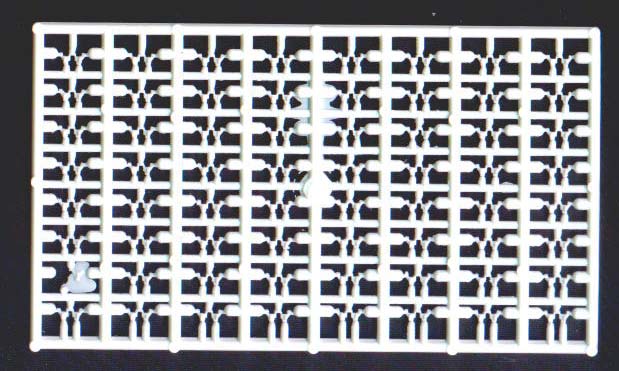
Then comes five, identical, chalk white colored trees, which hold the individual track links. Boy...are these TINY!!! (There are 320 links). One link, on each of these parts trees, is mismolded. So, you really only have 315 good ones.

The attachment points holding these teeny links to the sprue, is in five places and they look BIGGER than the links themselves. This is going to be tedious, fiddly work, to get them off the sprue and cleaned up. Something I don't look forward to.

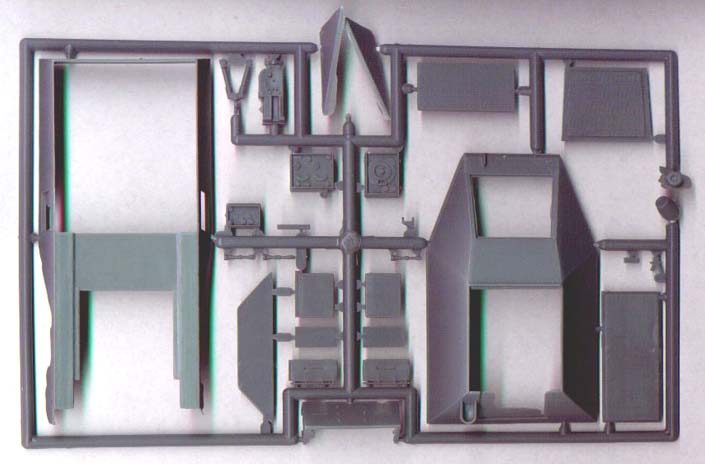
The final sprue in each is what separates the two kits: In the transporter this holds the walls, doors, canvas support frame for the rear open compartment, and a jack. (11 parts here) The parts on this tree all have shallow ejector pin, cup marks, on the face of them (right where it HURTS!). Some sanding and filling will have to be done to eliminate these. RPM could have placed these on the back side and not where all the detail is. Working around the rivet and raised detail will be a chore.

The last sprue in the command vehicle holds the upper superstructure and panels, a jack, radios, engine intake louver panel, donkey ear style binoculars, antenna bases etc. Again there are some ejector pin marks on the faces of the parts that are unique to this kit (25 parts here).

There are no figures included with either kit. Interior detail is very sparce too. There is scope for extra detailing to be added to either kit.

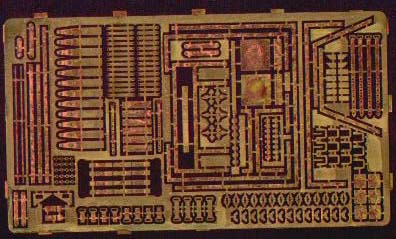
Finally, there is the brass PE fret. I count approximately 188 parts on this fret. There are numerous wing nuts, tie downs, brackets, riveted bands etc. etc. Not ALL these parts are called out on the instructions to be used to make these kits. I suspect this fret is designed to be used in a number of other RPM kits as well as this one. A lot of the parts are teeny weeny too. I wonder how one can handle and glue anything so small!!

The postage stamp sized decal for the transporter holds six German national crosses: three are white and three are black. There is also three white 15th Panzer division marks and three Afrika Korps palm tree and swastika emblems, also in white.

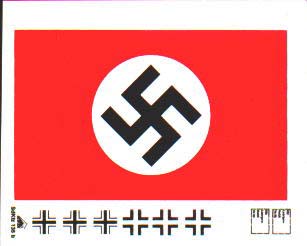
A larger decal sheet is provided for the command vehicle. This holds a Nazi swastika air recognition flag , two styles of national crosses, tactical marks for a tracked artillery unit, and loading stencils for when the vehicle is rail transported.

The instructions are 9 1/2" x 6 1/4" page size. The main instructions, for assembly of the plastic parts, are four pages long.

Page one gives the box art, in black and white, next to the history of the vehicle in Polish language only.(the kit is made in Warsaw, Poland). This is followed by painting and decaling drawings. These black and white drawings are the same as the color profiles on the side of the box. The bottom of the page shows two parts tree drawings with the part numbers shown.

The top of page 2 shows two more parts trees drawings and a paint number reference chart. From the bottom of page 2 to page 4 we are given 21 and 26 assembly drawings.

Another, single page instruction sheet (printed on both sides) gives us a numbered parts tree drawing for the brass PE fret. Eighteen drawings show how to use some -but not all- of the PE parts. You will definately have tons of these parts left over for your parts box after fully assembling these kits.

Conclusion

Transporter: I would grade this kit as fairly good. The teeny track links, ejector pin marks (and some sinks) on parts mentioned earlier are downers. However, the kit should make up nice with a lot of care. But joining things is tedious too.

Command vehicle: I would grade this kit a little better than the Universal Carrier kit. There are no sink marks or ejector pin marks this time. You still have to contend with the teeny track links and butt joining parts. Adding that weld detail, mentioned earlier will be a chore too.

Neither kit is recommended for the novice modeler, but OLD PROS should not have too many problems. It is a off-beat subject and should draw some stares on any display shelf. Not something you see every day.

Both kits were purchased from Greatmodels web store.