Building Amodel's 1/72 Rutan Voyager
By Will Perry
 |

|
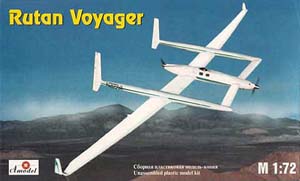
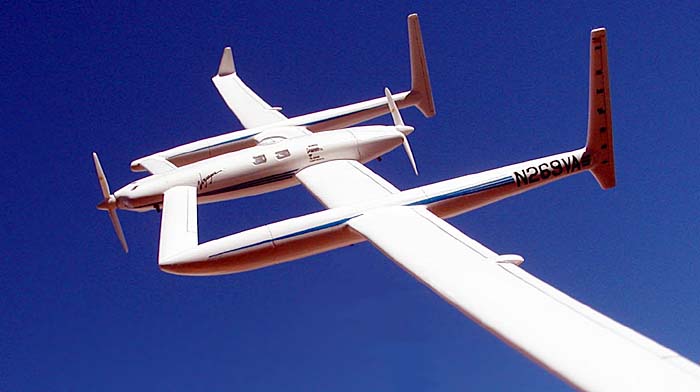 Amodel is a Ukrainian company whose products follow the familiar limited run formula - unusual subjects, indifferent molding, and challenging construction. Though the kit compares well to drawings in the September 1987 Modelar (Cz), I have strong doubts about the accuracy of the main fuselage. In most photos, the central crew pod looks like a squared off cigar; the kit pod looks more like a squashed Twinkie. The kit is molded in a soft white plastic that is easy to cut and sand - good thing, ‘cause there's lots of cutting and sanding to be done on this kit. Attachment points are thick, every part has ample flash, and edges are lumpy and uneven. The appropriately sparse surface detail is scribed; the lines are reasonably even and straight.
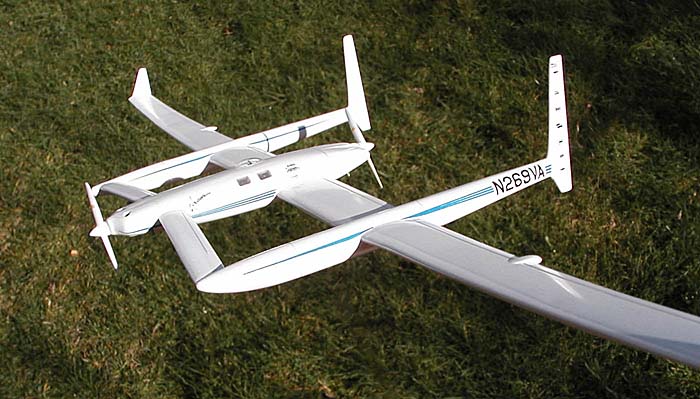 Getting the parts to look like parts, especially the propellers and those long wings, took a couple of evenings with files, X-acto knife, putty, and sanding sticks. Because I was modeling the aircraft in flight, I used hot water to curl up the outer wings, breaking one in the process and adding yet another seam filling task. At least I didn't have to deal with the hopelessly crude landing gear. A simple heat-and-smash provided a decent teardrop canopy to replace the crude kit item.
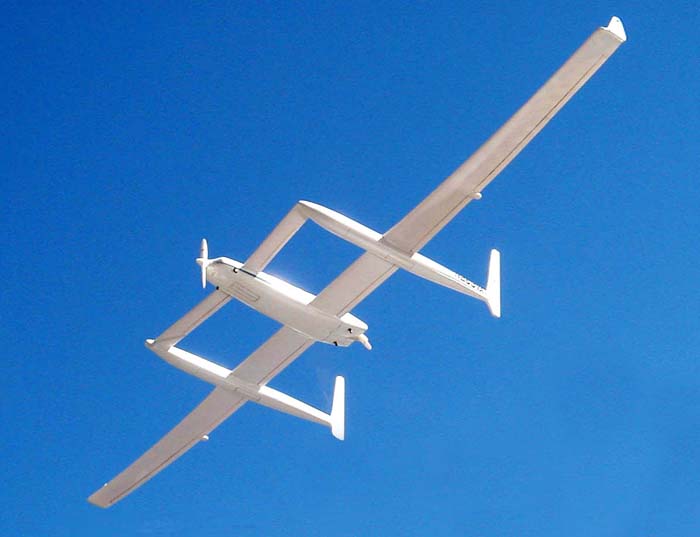 After the fill and sand marathon, I masked off openings in the fuselage with Kristal-Kleer, and squirted on Model Master Boyd's white primer. This revealed flaws that required a couple more evenings of touchup, followed by another primer coat, and a rubdown with an old T-shirt. Three thin coats of Tamiya gloss white followed, and then the decals.
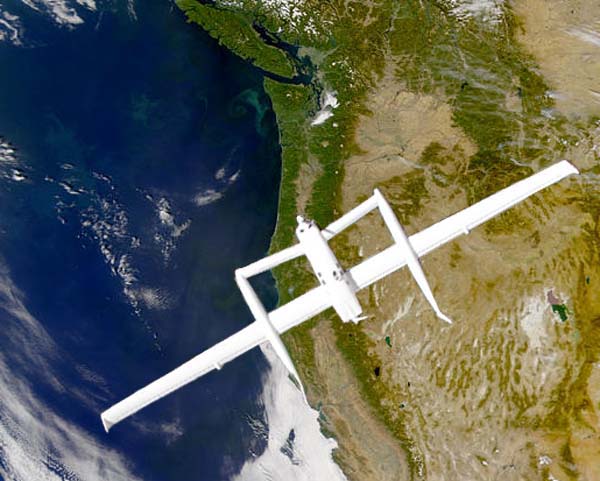 A couple of coats of thin Glosscote finished the finish. Because the kit transparencies were so lumpy and dingy, I used Kristal-Kleer for the side windows, but the area is convex and the glazing dries concave; if I did it again, I'd scratch build some windows. A soaring-above-the-clouds stand was constructed using brass rod, a hunk of scrap wood, and some cotton balls.