• Menu
  • Home
  • Columns
    • Industry News
    • Editorials
    • Now and Then
  • Features
    • Armor
    • Automotive
    • Aviation
    • Figures
    • Ships
    • Space/Sci Fi
    • Special Reports
  • How To
    • Construction
    • Detailing
    • Painting
    • Finishing
  • First Looks
    • Armor
    • Automotive
    • Aviation
    • Figures
    • Ships
    • Space/Sci Fi
  • New Releases
    • Armor
    • Automotive
    • Aviation
    • Figures
    • Ships
    • Space/Sci Fi
    • Book Reviews
    • Tools
  • Gallery
    • Armor
    • Automotive
    • Aviation
    • Figures
    • Ships
    • Space & Sci Fi
    • Drawings
    • References
Internet Modeler : Features: Aviation RSS News Feed

Huma 1/72 Junkers Ju-288-C

By Allan Wanta
History

"As replacement for the Ju 88 planned, the radical Ju 288 was a completely new construction with (1600 HP) radial engines, perpendicular double tail unit and double main landing gear. The prototype flew in January 1941. Originally a bomb additional load was planned by 5000 kg, which had to be substantially reduced however because of difficulties during the handling. Gradually one inserted ever stronger engines, likewise a remote controlled cannon armament. When in the year 1943 many German bomber projects were painted, among them also the Ju 288, was further pursued the Ju 288 for the ground-combat engagement role using enormous single firing cannons like the equipment 104 Muenchhausen with 35.56 cm calibers. It did not come however any longer to the quantity production."

The above excerpt was from theĀ www.unsere-luftwaffe.de web page using Google translation software, gotta love it.

The Kit

It's been a long time coming, this new Junkers Ju-288-C kit. Was it worth the wait? Well, I'll obviously have a word or two on that. But the kit is here, and it looks very buildable. Here are a few words of wisdom to those who have the idea of wanting to building this kit.
First word of wisdom, at least I think it's wisdom, study the instructions. The instructions are typical Huma, perhaps not as bad as the above translation, but with exploded assembly diagrams, not extremely clear placement of parts, but a great paint diagram. The smaller parts placement is going to be interpreted differently by each modeler so don't be too concerned. The small black and white interior photos on the instructions are helpful but are too small to be of much use.

Assembly of the kits parts is just like all their other kits, good moldings, little flash, soft interior details.

As a matter of fact, this is one Huma kit that doesn't give 100%. Details are soft and often glazed over, when the detail is there it's not accurate. Seems to me the kit was languishing in development so long, Mr. Huma decided to kick this kit into the marketplace, finished or not. Gone are the delicate, almost photo-etched plastic parts I thought were so well done? German technology this kit ain't.

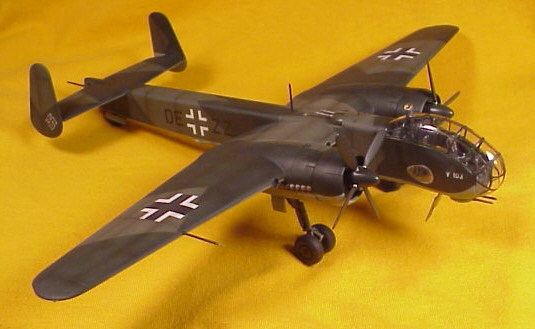
Fuselage parts fit extremely well, but there are two bombs included that fit in a bomb bay that doesn't open. Major surgery is required to show off a semi-detailed bomb load. Wings again fit well together, but the air intakes almost look like an after-thought. Regarding the engraved panel lines, it harkens back to the old Matchbox kits, a bit wide and deep, even for the 21st century. Some primer will surely tone those down.

Overall fit is very good; little filler will be needed anywhere. The engineering is pretty good, some well thought out areas, like the landing gear. The detail on this is better than the rest of the kit, watch the gear doors though. On the ground all the main gear doors are closed except the two directly next to the struts, all others are difficult to blend into a smooth nacelle because of size and shape problems. The landing gear was assembled without too much trouble, but again some better instructions on placement of the parts would have made things a tad bit easier. Wheels are perfect but require that the main gear, or at least most of it, be assembled when the wing parts are assembled making final painting more tedious.

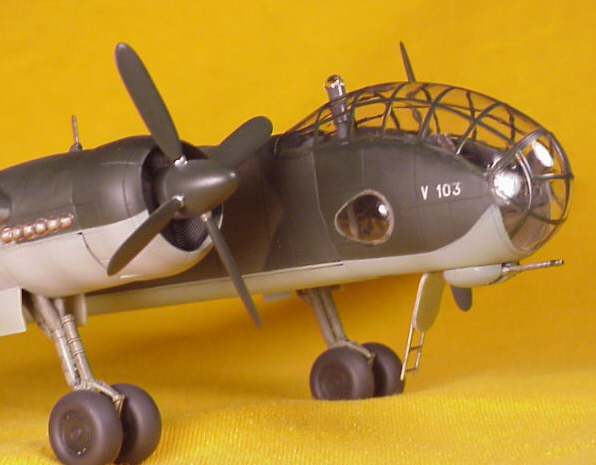
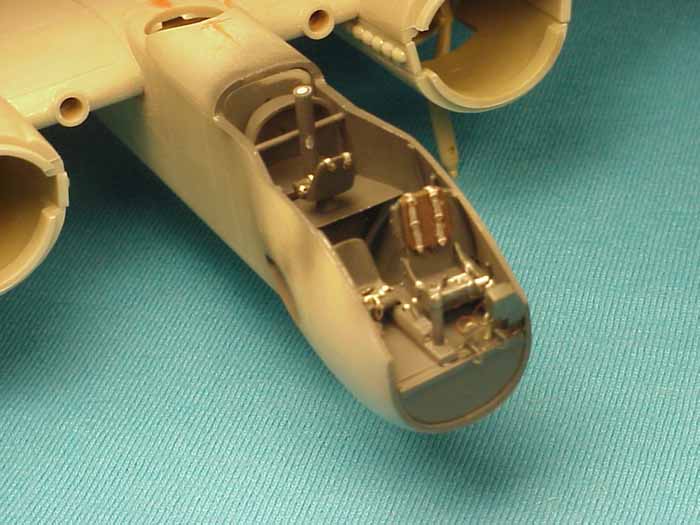
Cockpit assembly is easy, maybe too easy. A lot of detailing can be done here due to the fact that the canopy is very clear and very large. Most of the interior is simplified, decals for instruments, generic seats, and look Ma, no sighting periscope for those gun barbettes. That's not even funny. Even the Special Hobby Ju-388 had the periscopes used to control and fire the tail barbette, here we have none. Scratchbuilder quality time is going to be spent here.

Some details from the Ju-388 are used to enhance the front office, as well as etched seat belts from the spare bin. The canopy parts are packaged loose in the plastic bag that contains the rest of the sprues, it ended up becoming very scratched and scuffed. A dip in Future wax cleared up most of the problems. The fit of the clear parts was exceptional, not much in the way of fiddling here, but be careful not to miss-alien the top and nose pieces.

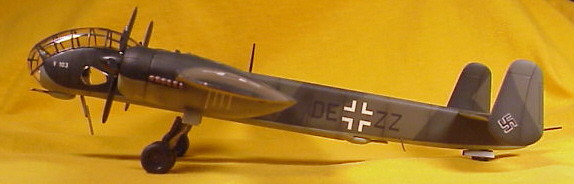
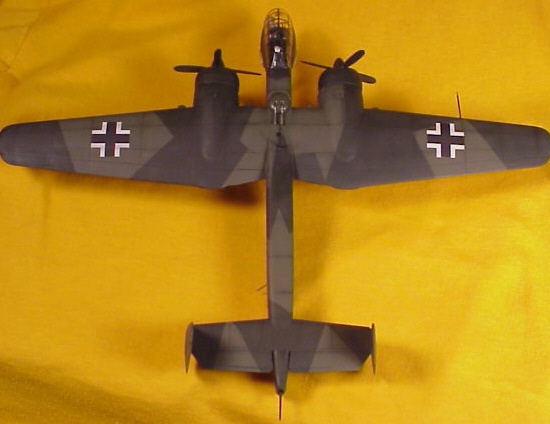
Overall painting is done in the 70/71/65 scheme as were most bombers of the period, decals are a bit suspect and even with enlargement of the fuselage radio call letters, they still looked small. Missing are the 'V-103' for the tops of the fins, those supplied are used on the forward fuselage, or fin, but you'll still need an extra set. Please overlook the absence of the tail fin V numbers, I was lazy.

Conclusion

This is not a difficult model to make; however I feel it was oversimplified to be more mainstream. Being more like a Matchbox kit is not necessarily a bad thing, but when a 2001 model year kit is marketed, one should not accept the missing details, no Ariel or pitot tube. And how is the radio-gunner position supposed to aim and fire the remote guns, with out a periscope on the top and bottom of the fuselage? See what I mean? I rate this kit a 8 for FUN, a 6 for difficulty, and a so-so 5 for the uneasy feeling that this kit should have been a 9 in the cool rating. Bravo to Huma for the chance to finally build their kit, after a muti-year wait.