
Revell/Germany 1/700 USS Wasp-Class LHD
By John Lester
 |
Background
 The Wasp-class multi-purpose amphibious assault ships were designed as successors to the Tarawa-class and replacements for the remaining LPHs still in service at the end of the 1980s. As large as a WWII Essex-class fleet carrier,Wasp and her sisters were designed to serve as the flagship for an Amphibious Ready Group (ARG), with command and control spaces for both the Navy ARG staff and the command element of a Marine Expeditionary Unit (MEU).
 On a normal deployment, they typically carry the bulk of the MEU’s Aviation Combat Element (ACE) – perhaps 30 CH-53’s, CH- 46’s, AH-1s and AV-8s – as well as most of the Ground Combat Element’s vehicles, equipment and personnel. They were the first amphibious assault ships designed to accommodate the Landing Craft – Air Cushion (LCAC), the Navy’s large hovercraft which provide the capability to land embarked forces by sea from over the horizon. With their modern command and control suite, ‘spacious’ accommodations for both personnel and equipment, and large medical facility, they are also well suited to a range of duties, including humanitarian assistance and rescue operations.

USS Wasp (LHD-1) entered the fleet in 1989. She has since been joined by five sister ships: USS Essex (LHD 2), USS Kearsarge (LHD-3), USS Boxer (LHD 4), USS Bataan(LHD 5) and USS Bonhomme Richard (LHD 6).
The Kit
 I’ve wanted a model of these ships ever since being assigned to USS Wasp (1992-1994). When I found out Revell in Germany had finally popped a kit, I couldn’t wait for them to make their way to the US – I had to order one as soon as Hannants [http://www.hannants.co.uk/] had them in stock.
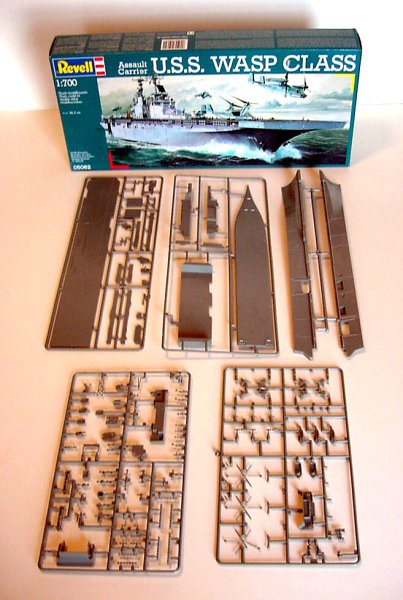
Upon ripping open the package the femailman left on my doorstep I found the standard flimsy cardboard box Revell favors these days. The painting on the front depicts a stirring scene, with Ospreys launching and Harriers appearing to land, and Wasp herself charging through a steelly sea. Artistic license: outside of trials, Ospreys haven’t even visited the ship that I’m aware of.
Inside the box are 142 grey styrene parts, a standard Revell instruction booklet, and decals. The styrene is standard Revell – medium grey and somewhat soft, with crisp details and few flaws. In addition to the ship, you get several Harriers, Ospreys and CH-53’s, the mobile crane and some other flight handling vehicles, two boats and 8 or 9 little shapes that apparently represent zodiac boats. All these accessories are molded as finely as can be expected with injected plastic – meaning there’s a lot of detail that’s over-simplified.
 The hull comes in two pieces which depict the ship from the waterline up. Most of the openings on the sides of the hull (for refueling stations, ready lifeboat, etc.) are depicted as indents with none of the equipment in them. A hangar bay of sorts is provided, but there’s no detail at all for the bulkheads or overhead – and let me tell you, that’s one area that’s never bare on the real things.

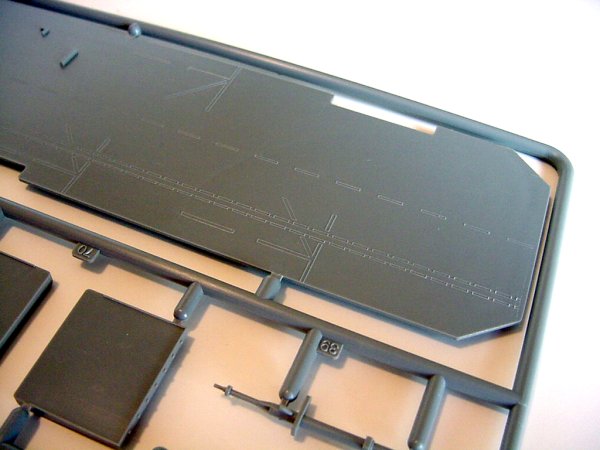
The flight deck has finely raised lines for all the markings but lacks any representation of the numerous padeyes. Also missing are the posts that line the gallery decks (the platforms immediately below the flight deck – these are shown in the box art). In fact, except for the liferaft canisters, there’s no detail on the gallery decks. To be fair, though, most of what’s there could only be represented by etched brass.
 Instructions come in the usual newsprint pamphlet and consist of 35 assembly diagrams plus a farcical diorama scene suggestion (more on that in a minute). They’re easy to follow and quite clear. Marking guides in the form of detailed line drawings are provided for USSWasp and USS Essex.
Decals are provided for the flight deck markings and ship’s hull numbers, plus a few for the aircraft and the two ship’s boats. They’re also typical Revell: matte, thin enough and well registered. The colors look right – at least for a freshly painted ship.
Accuracy
So, what comes in the box is essentially decent, for a plastic ship kit in this scale. An etched brass set will work wonders for things like the deck safety netting, lifelines, railings, ladders, fire- fighting equipment and the posts that support the gallery decks. What about the rest? I don’t trust my memory, but I do have a number of photos ofWasp from my time aboard, plus an exercise in which I participated in 1995, where she was the flagship. Most of the detail included is accurate, except for the following:
-
There was only one missile launcher on the deck in front of the bridge area, a BPMDS box (part 9). What part 59 represents, I dunno, but it wasn’t there in 1994.
-
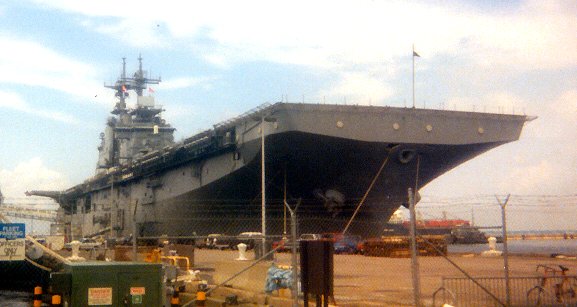
The configuration and number of antennas perched atop the superstructure and masts appears to represent the Wasp fresh from the slip in 1989. Every one of the ships has since received new and different communications gear and sensors, not all of them at the same time or even in the same mix. You really need photographic reference from the particular period in the ship’s life you wish to model – such as the two shots I’ve included with this review – to be completely accurate.
-
Missing behing the signal bridge are the two “flag bags” (large fiberglass boxes that hold signal flags) that flank the foremast.
-
The CH-53’s appear to be –D models, and not the –E type in service from at least 1990.
-
No LCAC’s are provided for the well deck (it can hold three). Instead, you get these ridiculuous shapes that look as if they’re supposed to be rigid inflatable boats with outboard motors, like the ready lifeboat. You can use one where it calls for the ready lifeboat in step 27, but chuck the rest.