Geisha Japan 1850 by PiliPili
By Stephen Jamison
 |

|
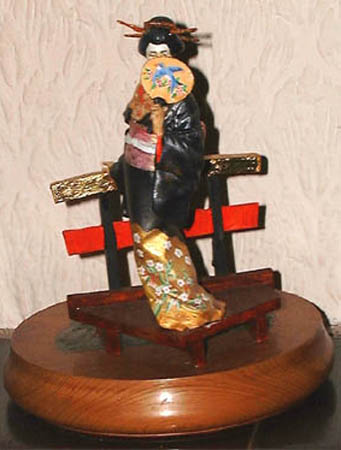
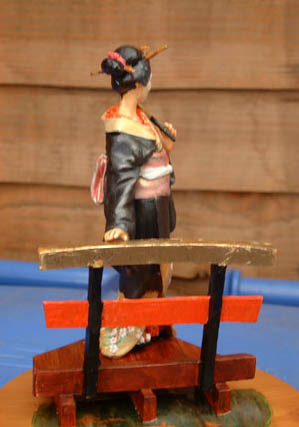 The kit comes in grey resin complete with part of a Japanese bridge. The parts are virtually flash free (except the bridge which did have to be cleaned up a bit), moulding lines are very faint and difficult to find. The casting is the usual standard to be expected from PiliPili - superb. The figure is posed standing on the bridge with one hand resting lightly on the handrail and the other holding her fan before her face in a very oriental fashion. The ethnic orgins of the figure are not in doubt - she looks very Japanese. My knowledge of Geisha's dress is based on a few nights surfing the net and I am not even going to try to explain any of it or use the correct terminology, the more learned amongst you can correct my piece.
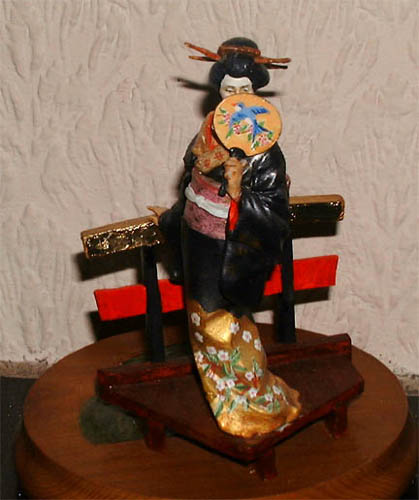 Assembly is very straightforward and uncomplicated, so I will not refer to it at all. I wanted the kimono to be as striking as possible, so I chose to represent a dark grey and gold silk. For the Dark Grey silk I painted the upper part in a mixture of Windsor and Newton Pewter and Windsor and Newton Sepia overall, I highlighted using more or less straight Pewter with brighter highlights were done with Windsor and Newton Silver. The shadows were done by adding progressively more Sepia, with very dark shadows being straight Sepia. The collar and bottom third of the kimono was to be gold with an embroidered design on it. I painted it in a mixture of Windsor and Newton Jaune Brilliant and Windsor and Newton Gold, with highlights in straight Gold, shadows were a mix of Gold Ochre and Gold. The upper garment was painted Cadmium Red and the cummerbund was painted a pale pink. This was all set aside for a couple of days to dry off a little.
 Once the kimono and undergarment were dry I painted on embroidery. The undergarment was given a floral design of white daisies with royal blue centres; the gold silk on the kimono was painted with a cherry blossom design. The fan was given a branch of cherry blossom and a blue bird. The one thing I experimented with that exceeded my expectations was the cummerbund. I lightly over-painted the pink with Winsor and Newton Gold ink and was delighted that it looked as though this was a pink material with gold interwoven. I painted a bamboo design in coral coloured acrylic to complete it. The hairpins, comb and fan were attached and the whole thing pinned and glued onto the bridge.
 The base was painted in various greens in swirling designs to represent weed and gold fish were painted on top. Once dry, the whole lot was varnished and then given a fairly thick layer of clear epoxy resin which both fixed the bridge permanently and gives the appearance of water.