• Menu
  • Home
  • Columns
    • Industry News
    • Editorials
    • Now and Then
  • Features
    • Armor
    • Automotive
    • Aviation
    • Figures
    • Ships
    • Space/Sci Fi
    • Special Reports
  • How To
    • Construction
    • Detailing
    • Painting
    • Finishing
  • First Looks
    • Armor
    • Automotive
    • Aviation
    • Figures
    • Ships
    • Space/Sci Fi
  • New Releases
    • Armor
    • Automotive
    • Aviation
    • Figures
    • Ships
    • Space/Sci Fi
    • Book Reviews
    • Tools
  • Gallery
    • Armor
    • Automotive
    • Aviation
    • Figures
    • Ships
    • Space & Sci Fi
    • Drawings
    • References
Internet Modeler : First Looks: Aviation RSS News Feed

Luedemann 1/72 resin Oeffag/Mickl H (A11) Austro-Hungarian flying boat fighter

By Grzegorz Mazurowski
The Plane

For all those who like unusual, but operationally used airplanes, I have something special: an Austro-Hungarian WWI flying boat fighter – built in one example only – which was used extensively on the Adriatic Sea by Austria's highest scoring naval ace, Gottfried Freiherr von Banfield.

The plane was designed and built especially for the ace by Josef Mickl at the Oeffag factory in Wiener-Neustadt. Known under various designations, as Oeffag/Mickl H, as "A11" (Navy number) or simply as "Blue Bird" or "Blue Wonder", this was Banfield's favourite warhorse from March, 1917, until the end of hostilities in September, 1918. It was used day and night, as a successful fighter and as an attack airplane against Italian motor boats. The airplane was used in two different paint schemes: first in CDL/varnished wood scheme with the "A11" number in white, and later, at personal Banfield' s request, it was painted entirely in medium blue with a black "A11" on the cockpit sides.

The Kit


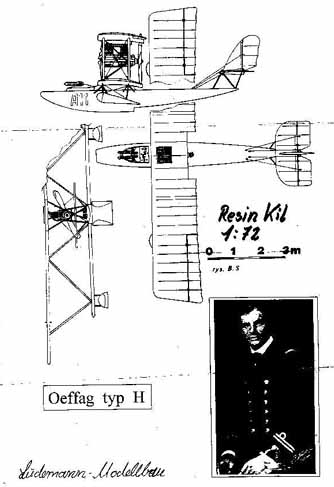
It's a typical Luedemann's kit: a basic instruction sheet with 3-view drawings and resin parts only. All main parts are very precisely shaped in ivory coloured resin.

The fuselage is cast in a single piece with an open pilot's cockpit. There is no internal structure; I doubt this is the producer's negligence but rather is due to the lack of documentation. The only included cockpit equipment is the seat and the Schwarzlose machine gun. The fuselage upper surface is cast very well with fine details but the sides and undersurfaces have many small pinholes, which fortunately are easily filled with putty and sanded without risk of losing any details since those surfaces are flat. The wings have very fine rib details and thin trailing edges. The upper wing radiator is nice, but seems to be copied from the Hit-Kit Oeffag D.III short run model. There are some pinholes in the wings, but they can be fixed with a small amount of putty.

The tailplane, fin and rudder are similar to the wings, with very nice thin surfaces.

A 200 hp Hiero engine and a propeller, although not as good as in Choroszy or Ardpol kits, look very decent, and are certainly usable.

The worst things in the kit are the struts and the side auxiliary floats. The wing struts are much too short and so are unusable. The wing floats have the wrong shape: photos indicate, that they should be oval in cross section, and they are provided as flat rectangular wedges. Also, one of the engine bearers isn't fully cast and it looks like it will be easier to make a copy of the correct one than to repair miscast part.

For decals, you can check Americal-Gryphon set "#146 k.u.k. Seeflieger (I) Alb., HB, Oeffag"which should include full markings for A11. The Austro-Hungarian Navy set made by Pegasus also includes good crosses and crests but no serials.

Accuracy

The accuracy of the model is one big "hmmmm." as there is no precise documentation (AFAIK) of this unique airplane. All we know is reconstructed from a few photographs which don't show entire airplane well enough. The most controversial thing is the shape of the wingtips, they could just as well have been rounded as straight. Luedemann made them straight (which in my opinion is OK) but there is no proof that they weren't rounded. Also, the precise tailplane shape is unknown, and the real one could be more rounded than in the model.

The accuracy of the other parts seems fair to me, with the exceptions noted above. I have no data about the exact dimensions of the airplane.

Conclusion

I like this model very much, even if I will have to scratchbuild many details. The main parts are very good and with a little work all necessary details can be added, mostly to the interior and to the exposed engine. For detailing the fuselage interior, it will be best to drill into the fuselage with a motor tool from the bottom, remove the unneeded resin, and then cover the hole with plastic card after completing all the detailing.

Acknowledgment

Big "thank you" for Karen Rychlewski for language help!