Pro Modeler 1/48 P-38F/G/H Lightning
By Chris Banyai-Riepl
 |

|
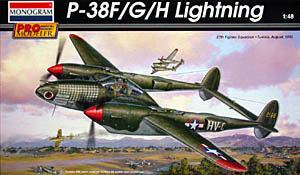
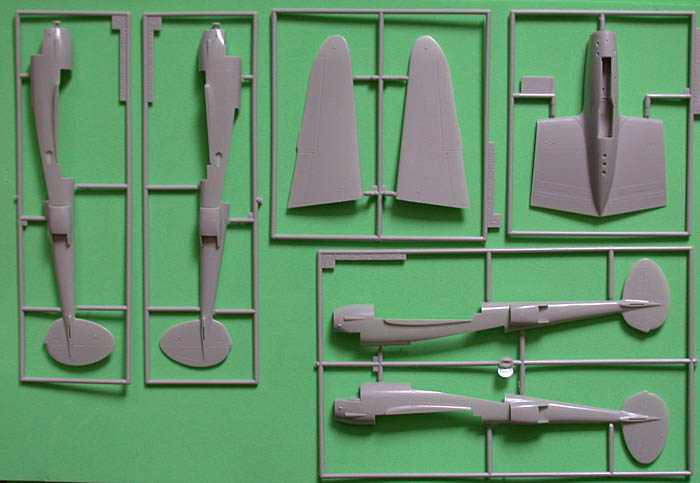 If you are scratching your head and wondering just what P-38 kit this is, the answer to your question is Hasegawa. This is a reboxing of the nice Hasegawa kit, but with new decals and a nice instruction sheet complete with detail photos courtesy of Detail & Scale. The kit comes molded in light gray plastic, with recessed panel lines throughout. The moldings are very crisp as is expected from Hasegawa, with no flash present.
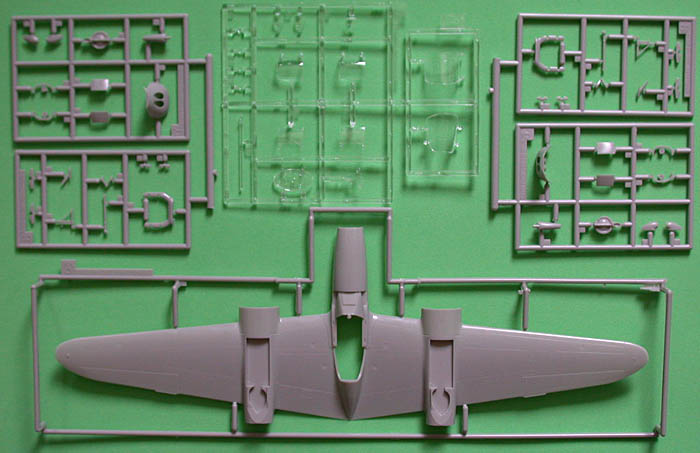 Once the cockpit is done general construction can begin. Due to the unique shape of the P-38 there is no easy way to mold things in injection plastic, and this kit is no exception. The twin booms are separate and are split into right and left halves. Separate main wheel wells are sandwiched inside, while the radiators on either side of the booms have separate front cowling and rear doors. The carburetor scoop is also separate and is split into top and bottom halves. The completed booms then fit onto the one-piece upper wing, which also incorporates the upper section of the fuselage pod. Outer lower wing panels and the lower center section make up the rest of the main assembly. With this many parts making up the major assembly there is a lot of potential for filler, but with careful dry fitting you can eliminate or at least reduce the amount needed.
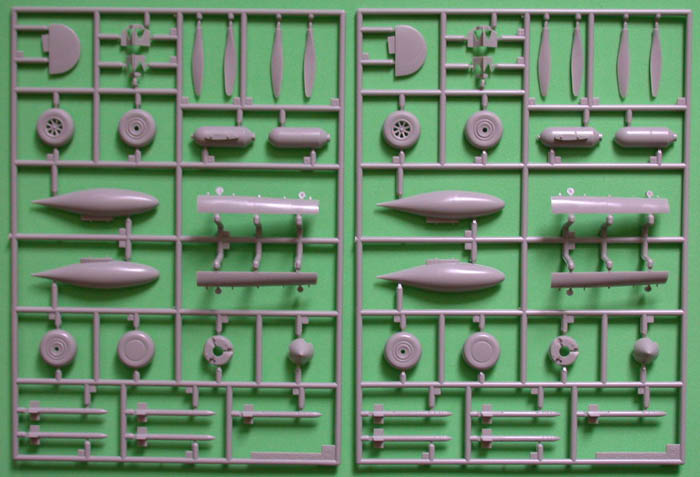 The remaining parts make up the small details, such as the superchargers and nose guns. The nose is separate, revealing Hasegawa’s plans to have more than one version. The stabilizer is in three pieces, the center section and two outer sections. The canopy is also split into five pieces, with another separate piece for the windscreen bulletproof glass. The propellers have separate blades and two-piece hubs. Final fittings include a pair of fuel tanks.
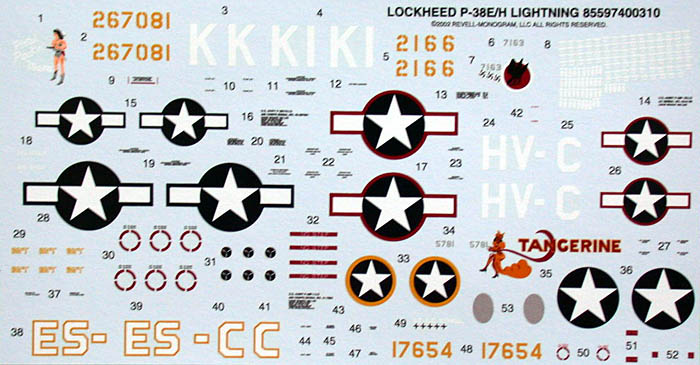
 27th Fighter Squadron, 1st Fighter Group based in Tunisia in August of 1943. This plane has a big pile of mission marks on the nose in the form of P-38 planforms painted in white, with another scoreboard of bomb marks. Next to the unit emblem is three kill markings as well, making this P-38 a rather busy one in Tunisia. Lt. Ervin C. Ethell of the 48th Fighter Squadron, 14th Fighter Group, in North Africa, flew the P-38F during the winter of 1943. The most striking item for this P-38 is the nose art, consisting of a dancing girl and the name Tangerine. The final option is the P-38H flown by Captain Donald McAuley of the 55th Fighter Squadron, 20th Fighter Group out of Kings Cliffe, England in November of 1943. This too also has nose art in the form of a woman and the phrase "Pistol Packin’ Mama". All three planes are finished in olive drab over neutral gray.
 Conclusion