• Menu
  • Home
  • Columns
    • Industry News
    • Editorials
    • Now and Then
  • Features
    • Armor
    • Automotive
    • Aviation
    • Figures
    • Ships
    • Space/Sci Fi
    • Special Reports
  • How To
    • Construction
    • Detailing
    • Painting
    • Finishing
  • First Looks
    • Armor
    • Automotive
    • Aviation
    • Figures
    • Ships
    • Space/Sci Fi
  • New Releases
    • Armor
    • Automotive
    • Aviation
    • Figures
    • Ships
    • Space/Sci Fi
    • Book Reviews
    • Tools
  • Gallery
    • Armor
    • Automotive
    • Aviation
    • Figures
    • Ships
    • Space & Sci Fi
    • Drawings
    • References
Internet Modeler : New Releases: Tools RSS News Feed

Strip-A-Kit Rides to the Rescue

By Tom Cleaver
sak.jpg (22125 bytes)

When confronted with a paint finish that didn't turn out, or a completed model that later isn't as interesting as it seemed to be at the outset, most modelers will throw up their hands at the thought of stripping the model and starting over. For years, the only way to do this was the old "home-remedies" of oven cleaner or brake fluid: nasty, smelly, environmentally- dangerous stuff that didn't really do the job 100%, and were as likely to ruin the model as solve the problem. Made-for-the purpose products like Easy Lift Off will take off most painted finishes, but getting into the difficult places involves leaving the stripper on long enough to run the risk of destroying the glue joints and disassembling the model. So-called environmentally-friendly strippers like E-Safe require full immersion of the part to be stripped, for a fairly long period of time, and still aren't very effective. No wonder most modelers think of stripping a kit as one of the tortures of the Ninth Level of Hell!

Fortunately, modeler Rick Fluke has come up with the solution: "Strip-A-Kit." This product is environmentally safe, practically odor-free, fast-working and effective.


The Test

In my experience, the hardest surface to strip is one painted with Testor's Model Master Metallizer. It doesn't come off from joints without putting ELO on long enough to ruin them, won't come up from surfaces where a decal was placed due to chemical interaction between the decal solvent and the paint, and generally leaves a surface that will not look pristine under a new coat of metalizer paint.

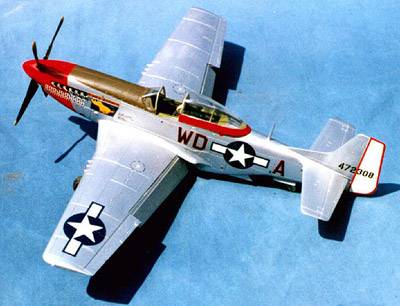
I got the 1998 IPMS-USA Convention decals that have Pierce MacKennon's P-51D "Ridge Runner III," an airplane I have long wanted in my collection. I have more than a few P-51s already, and really wasn't interested in doing another. I therefore took one whose markings had turned out not to be as spectacular as originally hoped, and made it my test-bed. It's a Tamiya kit with a True Details cockpit, a well-made model and a good candidate for a better scheme.

I painted on the Strip-A-Kit with a large paintbrush, and set it aside. Within minutes, a "foaming" reaction began (it doesn't really foam, but in comparison with ELO it looks like it does). Within 15 minutes, I could rub away paint with a soft cloth. I waited another 5 minutes, then cleaned off the model. All of the decals, all of the color acrylic paint, and over 80% of the metalizer finish came off this time. I applied S-A-K to those areas requiring a second dose, and 15 minutes later I had a model that was stripped down to the bare plastic, with the joints all still firm and no stripper inside the cockpit. The process of stripping this model down was almost enjoyable in comparison with previous experience! I washed it with soapy water, rinsed it off and let it dry.

You can see the final result in the picture above. Metalizer paints are thin enough that any surface irregularity you can't see in the bare plastic will show up under a coat of paint. There were none. It was like I was painting a brand-new model whose surfaces had never felt paint before.

Rick tells me Strip-A-Kit can also be used to create those difficult weathered-along-the-panel-lines of Japanese aircraft: apply a base coat of metalizer, cover with Future (S-A-K takes longer to strip with acrylics); paint on the camouflage finish; apply S-A-K in irreglar blotches along the panel lines, wait a bit (no set time, learn by experience), then strip off the S-A-K. Voila! A crapped-out, weathered finish with distressed aluminum beneath. I intend to try this myself sometime soon.

So, How Do I Get This Wonderful Stuff?

Rick Fluke's website URL is here, and he takes credit cards.

Snail-mail is:

Hangar 3 Arlee
P.O.Box 361
Arlee, MT 59821-0361

Retail price to modelers is: $8 per bottle plus $3 S&H. Postal regulations require he send no more than two bottles in any single package. Bonfide retailers can contact Rick via e-mail off of his home page to obtain wholesale prices and terms.

Based on my experience, Strip-A-Kit is going to be a regular in my modeling supplies from now on.