


The Gloster Meteor F.8/FR.9 Part 2: Camouflage |  |
The Meteor didn't spend all of its time in a shiny silver finish, though. Camouflage is essential to survival in a combat situation, and the Meteor wore camouflage from day one. But if camouflage is so essential, why did the British put such large and colorful squadron markings on their planes? Ah, well, no matter, as it gives us something neat to build models of!
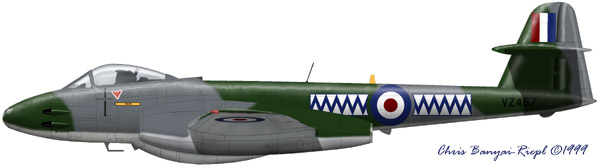
Meteor F.8 VZ467
"Winston"
This is an interesting Meteor example with a long and varied history. It has the distinction of being the last flying Meteor F.8, and is painted up to represent 615 (County of Surrey) Squadron RAuxAF. It was supposed to partake in a flypast celebrating Winston Churchill's birthday at some point in the 1970s, but because of the fuel crisis the flypast never took place. For a more detailed history, check out the article on the Czech Master Resin 1/72 Meteor F.8 by Damien Burke.
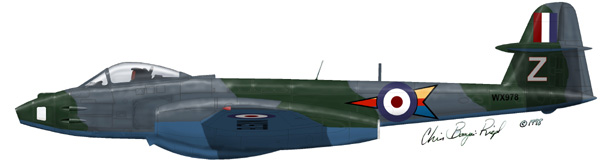
Meteor FR.9 WX978 'Z'
No. 8 Squadron
Middle East, 1959
A weathered example of the Meteor FR.9, this plane shows off the blue undersurfaces carried by the FR Meteors. The unit flash consisted of a chevron divided horizontally with sand, red, and blue bands. The white "Z" on the tail is outlined in red.
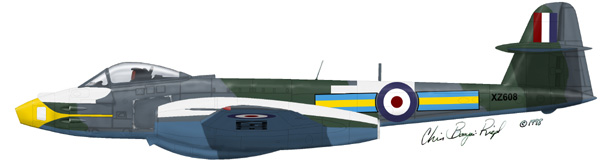
Meteor FR.9 XZ608
No. 208 Squadron
Aden, 1956
This is an interesting FR.9 seen at Aden around 1956. The typical markings of No. 208 Squadron can be seen, with the yellow nose and the blue/yellow/blue fuselage bands. The unique part is in the white sections covering the engine, nose, and rear fuselage. There is some confusion to these markings, as they were originally identified as being orange in the photo I based this profile from. The theory was that they were painted orange to aid in visibility if the plane went down in the desert. However, the specific locations of the overpainted areas made me suspicious. After looking at what is under these areas on the Meteor FR.9, I concluded that these areas were painted white to reflect heat away from the cameras, engines, and radio equipment. If anyone has a definite answer to this, please let me know.
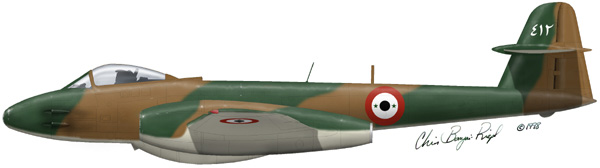
Meteor F.8 412
Syrian Air Force, 1956
Another foreign user of the Meteor was Syria, who flew F.8s during the Suez Crisis of 1956. Camouflaged in brown and green over a light gray, the Syrian Meteors even managed to see action during the conflict, with an RAF PR Canberra being shot down by a Syrian Meteor on November 6, 1956.
Sources
Meteor In Action, by Glenn Ashley, Squadron Signal Publications
Wings Over Suez, Brian Cull, Grub Street Press
Fighting Colours - RAF Fighter Camouflage & Markings 1937-1975, by M J F Bowyer 1975, Patrick Stephens, LTD.


 Air Intelligence 1/48 Scale Guide $20.00 Please add $3.00 Postage in the US. TacAir Publications |

Previous: Contents

