Detailing the Defiant: Classic Airframes' 1/48 Boulton Paul Defiant
By David Batt
 |

|
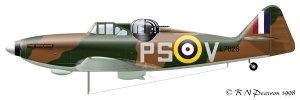 The Defiant’s claim to fame was when 264 Sqn recorded the greatest number of kills for no loss in one day - 37, on 29 May 1940 - that have ever been recorded. During the course of May 1940, the period of the fall of France and leading up to Dunkirk, 264 Sqn claimed 67 aircraft destroyed and an unrecorded number damaged against 14 Defiants and seven aircrew lost. This vindicated the theory of the turret-armed bomber destroyer, for most victories were scored against large formations of bombers, in the main Ju-87s and -88s. The secret was that the Defiant had to seize the advantage if it was to succeed, to be used aggressively and be able to choose its opponent.
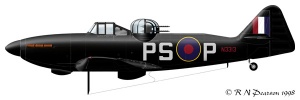 this formation to sea level where they were invulnerable to any attack from below. On 28 May ten of 264 Sqn 's Defiants were bounced by around 30 Me-109s and shot down six of their attackers with the loss of three of their own number.
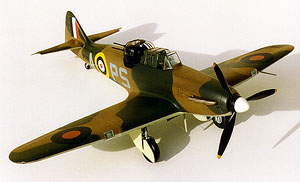 different defensive tactic. It appears that they were to fly straight and level in line astern as if they were some sort of aerial battleships, which would have given their gunners a stable platform while they did not have to worry about 'friendly fire' as all the friendly aircraft were in each other's blind spots. Put bluntly, this tactic didn't work and saw the debâcle that coincided with the end of the Defiant's day fighter operations, when on 19 July a formation of nine 141 Sqn aircraft were bounced on their first and only daylight sortie by, once again, 30 Me-109s and seven Defiants were lost against four Me-109s. Even so, one has to admit that given the odds of worse than three-to-one and hamstrung by incorrect tactics the Defiant was far from defenceless.
 The accompanying drawing shows the correct spinner profile for the Defiant Mk I, plus details of the interior of the rear fuselage. As the lower part of the gun turret is an open framework I thought much of the fuselage interior would be visible in the completed model. I was proved wrong on this, for the only part of the fuselage structure that is visible is that part immediately behind and below the gunner’s seat. However, there was some satisfaction in building all this detail in, and it can still be viewed by lifting the turret out of the model.
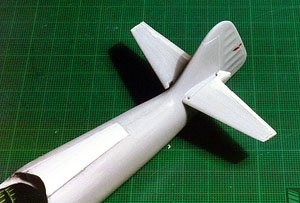
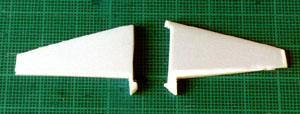 correct in span but was too short in chord at the root and had a noticeable triangular planform compared to the original’s emphatic diamond shape. To be fair the shortness in chord is only a matter of 1.5mm or thereabouts, but it does put the leading edge root in the wrong place relative to the base of the fin. However, thanks to the lovely easy-to-work plastic that Classic Airframes use it’s very easy to correct, and I made a start by separating the elevators from the tailplane along the kit’s moulded hinge line.
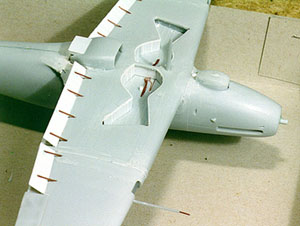 back and the outer 7.5mm back. The line of both inner and outer edges are correct, so the aerodynamic balance correctly ends up larger than it was.
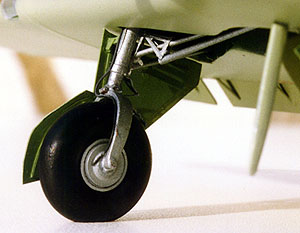 Another photo shows the undercarriage in detail with the correct arrangement of the undercarriage linkages, for they’re shown upside down in the kit’s instructions, and also how the oleos have been shortened by some 1.5mm to correct the model’s ‘sit’.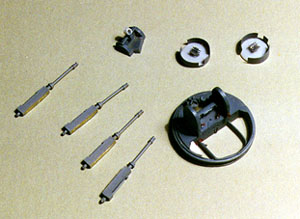
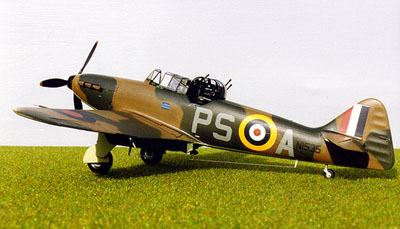
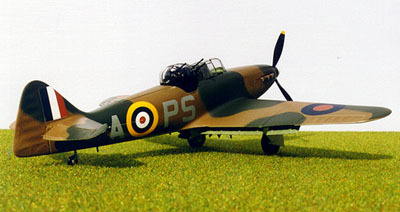 decal choice, the 264 Sqn aircraft ‘owned’ by the CO, Sqn Ldr Phillip Hunter. I used Xtracolor paints throughout, beginning with the undersides sprayed X-7 RAF Sky. Masking tape was used to get a hard demarcation before the uppersurface colours were added; X-2 Dark Earth and X-1 Dark Green, these colours being masked with my favourite method of paper masks held in place with tiny pieces of Blu-Tack to get a random mixture of hard and slightly soft demarcations.